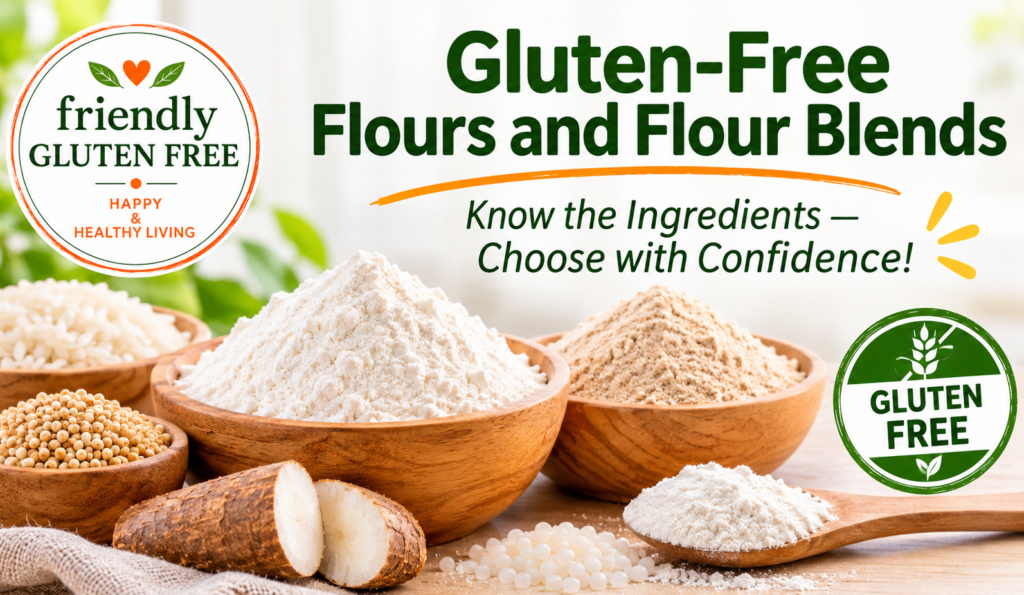
When we look at the labels of gluten-free flour blends, the ingredients we see most often are rice flour, sorghum flour, tapioca flour, xanthan gum (E415) and cellulose gum (E466).
These blends are sold either in separate packages for bread, cake and cookie making, or in all-purpose packages. When used according to the recipes recommended on the package, they generally produce successful and delicious results.
People who follow a gluten-free diet and use these blends should always look for the gluten-free logo and certification on the package. Flours and flour blends made from ingredients that do not contain gluten are not automatically “gluten-free” (cross-contamination can occur during production).
Let’s briefly go over the ingredients found in these blends.
Rice flour: Rice is produced in very large volumes across Asia. In Europe, Italy and Spain stand out as leading producers. In Türkiye, the main paddy rice growing regions are Thrace (Edirne), the Black Sea region (Samsun/Sinop) and Gönen (Balıkesir). Rice flour is used in two types, white and brown. It is naturally a gluten-free grain flour, and brown rice flour is a whole grain flour.
Sorghum flour: Sorghum, produced in the United States, Brazil, Nigeria, India, Mexico, China and Türkiye, is frequently used in gluten-free flour blends.
Tapioca flour: Production is concentrated in South America. Brazil, Thailand, Vietnam, Paraguay and Indonesia are among the leading producers. It is a fine, white starch that is naturally gluten-free, and it is a common component of gluten-free flour mixes.
Xanthan gum: Used in the food industry as a binder, thickener and stabilizer (European food additive code: E415). China, the United States and France are among the major producers.
Cellulose gum: Also known in the food industry as carboxymethyl cellulose (CMC). It is a very effective additive used as a thickener, water binder, volume enhancer and stabilizer (European food additive code: E466).
In my previous post, I touched on label reading and clean labels. I expect my readers will naturally question these two ingredients that carry E numbers. According to official regulations, they are considered safe by the U.S. Food and Drug Administration (FDA), the European Food Safety Authority (EFSA) and the Turkish Food Codex. The products in which they may be used, and the maximum amounts allowed, are also limited by law. Even so, I recommend consulting your doctor before consuming foods that contain these additives.
Whether you have to eat gluten-free or simply prefer to, you should be a good label reader. Wishing you a healthy and happy life.