As I keep writing about functional foods, gluten-free products, and celiac disease, I wanted to share something a little different this time. Alongside the usual technical ground — reading labels, choosing genuinely gluten-free products, watching out for cross-contamination — I want to look at how a gluten-free life can find an easier, more natural place in everyday life, through a slightly more psychological and practical lens.
A Restriction, and a Way of Life
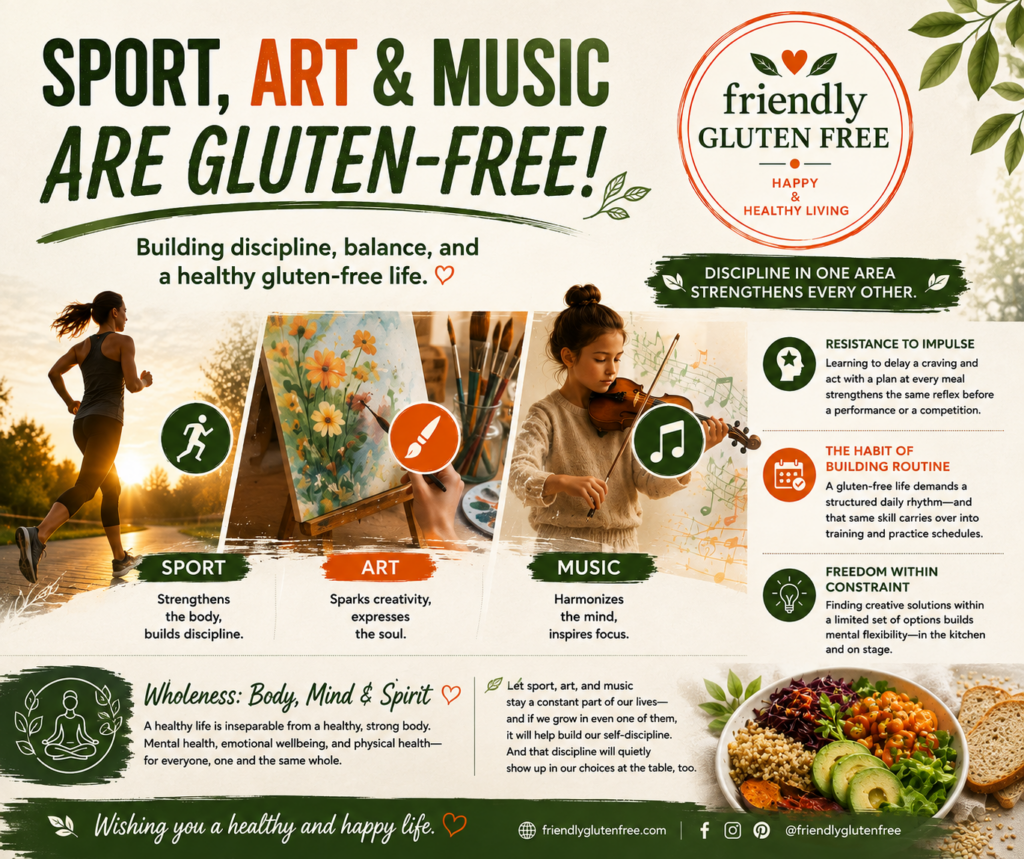
Eating gluten-free requires real discipline around choosing gluten-free products — not for everyone, of course, but for people with celiac disease it isn’t a preference, it’s a necessity. Until a new treatment is found, this restriction remains the most reliable way of managing the condition. One of the easiest ways to help this discipline become a natural part of daily life — for families and for children especially — is to keep every member of the family close to sport, art, and music.
A Discipline That Spills Over
There’s a concept in psychology called “spillover”: the idea that a behavior or emotional state from one area of life leaks into another. I like to think of it this way: gluten-free eating is a hidden discipline workout. Sticking to a gluten-free diet is, in practice, a quiet act of self-regulation repeated at every single meal, day after day — and that practice doesn’t stay contained to one area of life. It feeds into, and is fed by, the discipline built through sport, music, and art.
I believe that when we guide our children toward sport, music, and the arts, we’re making a real contribution to their self-discipline. Sticking to a training schedule, repeating the same movement until it’s right, pressing the same notes over and over until a piece is played correctly, using the body’s muscles consistently and deliberately, preparing mentally before a competition, planning ahead, coming up with alternatives when something doesn’t work — all of this builds a specific kind of discipline in children.
And the relationship runs both ways. The discipline built through sport and music also supports healthy eating habits. Someone with a regular training or practice routine already has the skill of “living with a plan” — and that skill transfers easily to tasks like preparing meals and making careful choices when eating out. Research backs this up: habit strength built in one behavior tends to increase consistency in other, seemingly unrelated behaviors as well.
This two-way reinforcement can be summed up in three points:
- Resistance to impulse: Learning to delay an instinctive craving and act with a plan at every meal strengthens the same reflex before a performance or a competition.
- The habit of building routine: A gluten-free life inevitably demands a structured daily rhythm — and that same skill for structure carries over into training and practice schedules.
- Freedom within constraint: Coming up with creative solutions within a limited set of options exercises the same mental flexibility, whether you’re in the kitchen or on stage.
Wholeness: Body, Mind, and Spirit
A healthy life is inseparable from having a healthy, strong body. Mental health, emotional wellbeing, and physical health are, for everyone, one and the same whole. Let sport, art, and music stay a constant part of our lives — and if we manage to grow in even one of them, it will help build our self-discipline. And that discipline will quietly show up in our choices at the table, too.
Wishing you a healthy and happy life.